Abalone

by J. R. Practix

dictionary with letter A

Abalone: n. an edible mollusk of warm seas that has a shallow ear-shaped shell lined with mother-of-pearl and pierced with respiratory holes. Also called EAR SHELL.

He was unnaturally attached to his daughter.

I’m talking about creepy stuff. So much so that he decided to kill her husband so he could have her all to himself. Since the father was a chef and the husband was also one, the weapon of choice was to poison some seafood with chicken salmonella and give it to this hapless young man as a gift to serve in his restaurant.

When the young chef served this particular delicacy, it made everybody sick, creating a secondary motive for someone to kill him other than the father who wanted to be wacky with the daughter. Do you follow?

I bring this up because the seafood selected to poison was abalone.

Now, it is a long drive (or swim, in this case) for me to find a connection to this mollusk, but I also learned, from listening to Goren investigate on Criminal Intent, that abalone is illegal to procure because it’s rare, and therefore extraordinarily forbidden–and for those who actually do acquire it–expensive.

I realize this doesn’t shed a lot of light on the life and times of this most uncommon mollusk, but it does explain why sometimes the only reference we have to certain words and ideas is through our own experience–or lack thereof.

So when I saw “abalone,” it made me think of Goren on Law and Order and the creepy dad who wanted to get too close to his daughter and killed her husband, emulsifying his body and bones in a meat grinder in the kitchen of his restaurant.

I’m sorry. It was the best I could do.
Abakan

by J. R. Practix

dictionary with letter AAbakan: an industrial city in south central Russia, capital of the republic of Kaskaskia, population 154,000.

For me, it was my grandfather’s root cellar. Now, if you don’t know what a root cellar is, it is an unfinished basement in an old farmhouse where they used to keep potatoes and various produce to make it last longer before rotting.

It was a scary place. It had stone steps that wound around a corner into the darkness, and as a child I was frightened to death to even open the door and look within. Matter of fact, my Grandpa died and the house was sold before I ever worked up the courage to know what was around the bend in the darkness.

Likewise, being raised in America during the time of the Cold War, I have much the same feeling about Russia. It is my geopolitical root cellar.  When you mention ANYTHING in Russia–like Abakan–I immediately get visions of the Soviet Union with wild-eyed, crazed Cossacks, hunching over big, red buttons, trying to decide whether today is the day that they will murder the imperialist Americans.

Now, I now know this isn’t true. I am a fairly sophisticated, intelligent person who has read a newspaper or two, and has even occasionally perused a news magazine. I understand that Russia is not out to get James Bond, nor is it trying to murder young children–or for that matter, brainwash us through socialist media to become communists ourselves.

But still, there is a chill that goes down my spine when I hear the word “Russia.”

I feel ashamed. I think it’s time for me to give my own version of “To Russia, With Love.” But I am reluctant. I still fear that around the corner there is a dark place lurking to swallow young boys who shouldn’t have been there in the first place.

Aren’t we all silly? But after all, silliness is often just belief that has not yet been exposed.

Abaft

by J. R. Practix

dictionary with letter A

Abaft: {nautical} adv. in or behind the stern of a ship. prep. nearer the stern than; behind: the yacht has a shower just abaft the galley.

It was weird.

One morning I put on my sweat pants backwards. I knew almost immediately–because the tag was in the front. Tags aren’t supposed to be in the front. They’re supposed to be abaft.

See, I found that out this morning.

Stubbornly, I decided not to take my pants off and put the tag abaft. It bothered me all day. I became convinced that my crotch was being crushed by a lack of cloth which was intended to caress my backside, and was now kissing up to my front portions.

It was so annoying that when I saw a public restroom in a shopping center, I went into the bathroom, took off my pants to turn them around.  As I was disrobing, another fellow walked in and saw me pantless. His eyes twinkled, obviously seeking an explanation.

“A religious practice,” I stated, making the symbol of the cross on my chest.

Though bewildered, he continued about his business and I restored my pants to normalcy.

Likewise, I once heard an English professor refer to the US as a backward nation because we still cling to our religious fervor. I smiled. I thought about how many times we refer to other countries as backward, and now to have ourselves thrust abaft was unnerving.

I have never used the term again.

Also, at one time we called people who were shy backward. Now we insist they have some attention deficit disorder and give them a pill. Obviously, medication is thrust forward and never abaft.

There are many things I wish were abaft. Prejudice. Anger. Violence. Stupidity presented as pseudo-intellectualism. I-Phones that don’t seem to have a “we” application. And for that matter–back to the original definition–being stern. Yes, wouldn’t it be wonderful if we actually WERE abaft to being stern? If we realistically stopped thinking that serious faces have deeper thoughts?  Yes, let’s put THAT abaft.

And for the record, I became so obsessed with my sweat pants and which way to put them on that I took a pair of scissors and snipped the tag. Sometimes it’s just better to be ignorant than obsessed.

Yes, obsession of that sort should be abaft.


Abadan and Abaddon

by J. R. Practix

dictionary with letter AAbadan: a major port and oil-refining center on an island of the same name on the Shatt al-Arab waterway in western Iran; pop. 308,000

Abaddon: (in the Bible) a name for the Devil or for hell.

A couple of evenings ago, after dinner with some friends, we got into a discussion on hell. It was either that, another piece of pie or trying to figure out how to play UNO again.

During this exchange, it quickly became evident that no matter how theologically involved each person was, the general consensus was that hell was not a very good place and that everyone hoped it would not be as advertised–an institution of eternal damnation. Most people agreed that there are consequences in life.

Now, hell is an easy one for me–and these two words personify it. Anyone who digs a hole in the ground, discovers oil and realizes he are rich–BUT the next notion that comes to his mind is, “How can I get richer off of this?” is pretty much a brat of hell.

For instance, if you follow the story of Lucifer, this was exactly his profile. He was IN heaven–actually holding a good position with a nice office in upper management–and one day, he decided, “I wanna get richer.” That’s why he ended up in the basement, here on earth.

Some oil refinery in Iran, filled with people wearing robes and desert hats, who get together and try, in the name of Allah, to annoy the western world by raising the price on their product, causing great grief to working moms and dads across the world, have, in my opinion, already laid the foundation and built the boundaries for hell.

Somewhere along the line, enough has to be enough. If you’ve got enough crap to buy a golden toilet seat, you may just have booked passage to Perdition.  The only thing that links us to the devilish is when we are not willing to be satisfied with our portion of extreme blessing, but instead want to “own it all.”

So heaven begins here on earth, with those who want to do heavenly things with each other. And hell is also instigated in the hearts of those individuals who are constantly trying to come up with ways to make the lives of others more hellish

I am sure the people of Abaddon would resent my tying them in with the lake of fire. But after all, when you live near an oil refinery, you should be careful playing with matches–especially when you’re sitting near a lake.

Abacus

by J. R. Practix

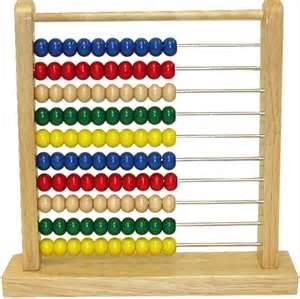
dictionary with letter AAbacus:  An oblong frame with rows of wires or grooves, along which beads are slid, used for calculating.abacus

I’ve heard of these things. I’m not so sure I’ve ever actually been in the presence of one. Listen to me go on. . . “Presence of one…”

It’s not exactly an alligator or the Queen of England. I always thought the Chinese used it for calculating–and since my society universally believes the Chinese are good calculators, I guess an abacus is quite efficient.

It looks complicated. It looks like one of those games advertised by Milton Bradley, with moving pieces that have seven pages of directions and you find yourself baffled by the second paragraph.

Can I be the first one to say that I think the calculator may be one of the greatest inventions ever known to man? It comes in second behind the fork. Never underestimate the power of that utensil.

Boy, that got me thinking. I gave such an importance to the fork, and left out toilet paper. I sometimes get picky about toilet tissue. It’s amazing how valuable it is, though,  even if it’s a second cousin to sand paper.

Anyway, back to the abacus. I was never good in math. I mean, I did great with long addition, subtraction, division, multiplication. But then, when it had to be explained instead of ciphered, with algebra, geometry, and we shall not even mention calculus, I started feeling like the last monkey staring across the plain at a group of humans building a fire. In other words, I saw the need, appreciated the effort, but had no way of fathoming the process.

I probably should go out, find an abacus and enlighten myself on its value, but instead, I think I’ll just go to the store and purchase a calculator.

Abaca

by J. R. Practix

dictionary with letter AAbaca: n. a large, herbaceous Philippine plant of the banana family that yields Manila hemp.

Have you ever wondered what would happen if you sat too near a fire at a church camp, wearing a shirt made out of hemp? It might give a whole new meaning to a “kum-bah-yah moment.”

I do think that for a few days, I’m going to walk around saying repeatedly, ” …large herbaceous….”  Now, I certainly am going to find reasons for such a proclamation, but I’m comfortable with the fact that no one knows what it means and most of us are too embarrassed to admit it, so I can probably get by with using it in some bizarre ways, and people will just nod their heads, feeling they are in the presence of true genius.

“Excuse me, ma’am. Do you offer any large herbaceous side orders with that Big Mac?”

How about this one? The next time I go to the swimming pool and an attractive young woman arrives, I will turn to my friends and say, “Well. That is certainly large and herbaceous.”

I will bet you that no one will even flinch–as long as I don’t do it in front of people under the age of fifteen, who are still innocent enough to admit they are verbally challenged.

Is anybody else trying to imagine a banana which is large and herbaceous, by the way, which is truly a Manila hemp plant?

                    “They call me Mellow Yellow, that’s right, Slim…”

Also gives a whole new meaning to “banana split.” Think about it.

I don’t know what use I will have for knowing what abaca is (aside from the prolonged usage of “large and herbaceous”) but I have a feeling that after writing this, I am going to be attacked in my dreams by a six-foot-tall banana smoking a bong, with Jimmy Hendrix music in the background.

I’ll let you know.

AARP, AAU, AAUP, AAVE

by J. R. Practix

dictionary with letter A

1. AARP: (abbr.) American Association of Retired Persons

2. AAU: (abbr.) Amateur Athletic Union

3. AAUP: (abbr) 1. American Association of University Presses 2. American Association of University Professors

4. AAVE (abbr.) African-American Vernacular English

If you don’t mind, I will take this series of initials to “initialize” my article for the day.

Seeing these four organizations lined up in the dictionary together really tickled my funny bone, because other than the dictionary throwing them together in alphabetical order, these four groups would not only be unaware of each other, but might be tempted to avoid contact.

It got me laughing. Wouldn’t you love to attend a party where a bunch of old people, aspiring athletes, college professors, reporters and hip-hop African-American rap stars got together to share the same pot of dip?

What a hoot!

I don’t think anybody would venture into that possibility, even for a mad-cap comedy. Too far out. But it IS the reason why fear and prejudice survive.

For instance, I was deathly afraid of a roller coaster until I sat in one. The theory and definition of a roller coaster bleached me white in apprehension. Likewise, being raised in a small town but far from rural America, I was absolutely petrified at the notion of being around barnyard animals. Pigs, cows, goats and sheep seemed like alien creatures out to suck my soul. And then, one day a friend of mine invited me out to the stables. Once I got used to the odor and learned how to carefully walk, I found the creatures to be quite domesticated, as long as you followed a few simple rules and honored their territory.

Bigotry is not the by-product of experience but rather, the lack of it.

Just think if the AARP, AAU, AAUP and AAVE got together somewhere OTHER than the dictionary. After the awkwardness wore off and the menu was reviewed for acceptability, conversation would naturally lend itself towards common goals and similar journey jaunts. It would end up being inspiring.

Segregation is not natural. Birds of a feather don’t really flock together, but actually tend to gather in promising trees near meadows filled with food sources.

It would just be so neat to see Grandma talking to some urban black man about her experience with blues music. Both of them would have to explore their resources and expand their boundaries. Meanwhile, the professor could amble up and explain the origins of both getting old AND the American ghetto. One of the athletes could be an anomaly … by being white.

Such a palette for colorful discourse.

So even though they only appear together in the dictionary, you would have to agree, our world would be better if these four actually did plan a meet, eat and eat. Yes, the world needs MEG’s–Meet, Eat and Greet.

It is only then that we will begin to birth a nation that has old, amateur athletes who are former professors that are completely well-acquainted with African-American vernacular.

Aaron

by J. R. Practix

dictionary with letter A

1. Aaron: (in the Bible) brother of Moses and the traditional founder of the Jewish priesthood

2. Aaron: Hank (1934- ) U.S. baseball player, full name Henry Louis Aaron. He set the all-time career record for home runs (755) and runs batted in (2,297). Baseball Hall of Fame (1982)

What do these two guys have in common?

People don’t have to have things in common. It’s kind of fun if they do, though.

My understanding is that Aaron from the Bible had a really long beard. Hank Aaron didn’t. A beard might get in the way of hitting home runs.

Speaking of that, maybe there’s a tie-in. Hank hit home runs and Aaron from the Bible was always dealing with people who wanted to run home to Egypt. Matter of fact, Aaron was so weak that he built a Golden Calf for people to worship. That’s when his brother, Moses, came down, took the Ten Commandments and tried to knock the Golden Calf out of the park.

You see? Another connection to baseball.

Must have been tough to be Aaron–the Bible one. Because his brother stuttered or had some sort of speech impediment, he was selected to do all the talking in front of the Pharoah. That had to be tough. Moses whispered in his ear and told him a plague of frogs was going to be sent to the Egyptian people, but HE was stuck with saying it out loud. Tough room, huh?

Hank Aaron had the most home runs for a career. That’s pretty impressive. That’s no flash in the pan. That’s not like hitting seventy in one year. That’s like doing it year after year. So maybe the similarity between these two guys is how different they were.

Bible Aaron did fine when things were great and the pitches thrown his way came right across the plate. Hank, on the other hand, hit ’em out of the stadium regularly, no matter who was pitching.

I guess what we can learn from this is … absolutely nothing, which is often the end result of object lessons. A teacher will work very hard to make a point, which totally escapes the grasp of the student. The teacher becomes more emphatic and the student pretends to understand–to escape getting in trouble.

Peaceful co-confusion.

Aargh

by J. R. Practix

dictionary with letter Aaargh: exclamation used as an expression of anguish, horror, rage or other strong emotion, often with humorous intent. late 18th C: imitative, lengthened form of AH, to express a prolonged cry.

I do love a spontaneous expression of surprised emotion.

I remember once watching my Grandma, as she inadvertently dropped the yolk of an egg into her cake batter in the midst of separating the white. An unexpected expression of her true feeling slipped past her lips, surprising her greatly–especially when she saw me looking up at her. She was so embarrassed.

I was a kid. I thought it was cool.

I don’t really know what constitutes the definition of “bad language.” But I do know that there are some words–which for some reason tend to have four letters–that you aren’t supposed to take out in public.

But how about those words we use as substitutes? Do they really work?

I, myself,  really hate the word “darn.”  And then there’s “shoot”. I never heard anyone use it but Charlie Brown. Forgive me if I prefer to cuss with more ferocity than Charlie Brown. I once knew a minister who used the phrase Jimminy Cricket. Gee whiz…

Sometime human beings just do human things and don’t need other human beings to criticize them for it. After all, don’t we just sometimes need God to … damn something? And sometimes the crap in the world around insists that it be called by its Bible name. And doesn’t the use of the “f” word sometimes resemble a “play-by-play?”

It’s confusing.

Aargh.

I’m sorry. It just doesn’t do it for me…

Aalto, Alvar

by  J. R Practix

dictionary with letter A

Definition of Aalto, Alvar (1898–1976), Finnish architect and designer; full name  Hugo Alvar Henrik Aalto. He often used materials such as brick, copper, and timber in his building designs to blend with the landscape. As a designer he is known as the inventor of bent plywood furniture.
Come on. The dude has four names. Let me give you a scale on numbers of names:
People who go by one name are divas. Beyoncé. Kermit. God.
Two names: Hard-working folk. John Deere. Jack Daniels. Martha Stewart.
Three names: Serial killers, authors and mascots. John Wayne Gaycee, Henry David Thoreau, Smoky the Bear.
But four names or more?  Really?? Fruitcake. And I don’t mean any disrespect.
Also, what’s the big deal about blending into the landscape? Isn’t that what cavemen did? “Hey, look, Buck! There’s a hole in this rock. We can live inside there without changing the landscape or ambience!”
And by the way…bent plywood furniture?? I have done that many times–just by sitting on it suddenly.
I’m sure Mr. Aalto is a nice guy, and probably came up with his own idea on how to blend things together…ala Reece’s Peanut Butter Cups and army intelligence. But if you ask my opinion, making furniture out of plywood is what causes many young married couples to end up purchasing living room suites that wear out long before the payment stops.